
PHOTO: NASA on Unsplash
Space is being widely viewed as the next domain of politics, diplomacy and warfare, and Australia is taking the space domain seriously.
This is demonstrated by the creation of the Australian Space Agency (ASA) in 2018 to protect commercial Australian interests, and the Defence Space Command in 2022 to protect Australian sovereignty in space. The establishment of these two stations comes from a long history of humanity turning its attention to space as the final frontier that signals where Australian national interests lie.
Defining operating in space
Australia defines space as the region above the Kármán line, a widely used distinguishing boundary between Earth’s atmosphere and outer space. There are also different levels to operating in space. Particularly, Low Earth Orbit, (LEO), Medium Earth Orbit (MEO) and Geostationary Earth Orbit (GEO). LEO is the most commonly used orbit due its proximity to the Earth’s surface, making it ideal for satellite imaging and communication.
Australian space policy is particularly focused on the protection of Australian interests of the satellite domain. Australia does not currently operate any weaponry in the space domain, but is undertaking research to be less reliant on allies and become a space power within its own right.
Why space?
Space is home to a range of operations, from communications and traffic management to intelligence and navigation. The space domain has been flagged as a recognised operational domain giving it the same legal and strategic understandings as the land, air, sea and even the cyber field. Therefore, these space-based services are seen as vital to protect as part of Australia’s national security interests.
Australia is also a member of the Combined Space Operations Initiative or CSpO, a collective of ten states coordinating national security interests in space. The current partners are: Australia, Canada, France, Germany, Italy, Japan, New Zealand, Norway, the United Kingdom and the United States. This group of states share a common agreement about protecting space as a domain, particularly the lawful use of space as directed by the five treaties and agreements of international space law and the United Nations Office for Outer Space Affairs.
The history of space as the final frontier
However, this focus on space is not a new phenomenon. Space has been flagged as an operational domain since the Cold War and the launch of Sputnik 1 on the 4th of October 1957. The Russian American Space race of the Cold War further spurred the possibility of the militarisation of space, and the space race became partially a race as to who could militarise space first.
American President Richard Nixon’s Star Wars program is one of the most famous forms of the militarisation of space. Star Wars is the colloquial term for Nixon’s Strategic Defence Initiative. At the heart of it was the idea of a space-based missile defence program that could protect the United States from a large-scale nuclear attack.
Space was first mobilised for war operations by the United States during the Vietnam War. Primarily, space was used for intelligence gathering, particularly focusing on weather analysis for the war effort. It is this use that is a good reminder that space operations are not just for physical weaponry but also for technologies that aid military efforts such as reconnaissance and intelligence gathering.
The first major instance of space playing a decisive role in a war was during the Persian Gulf War of 1990-1991. The Persian Gulf War, or the First Gulf War, is widely accepted as the first time space-based technologies had been comprehensively integrated into military operations and played a decisive role in the war. This is because space was no longer used solely for intelligence gathering, although intelligence gathering through the space domain was particularly pertinent in the first Gulf War. Communications and GPS positioning was used decisively throughout Operation Desert Storm.

PHOTO: Daniele Levis Pelusi on Unsplash
So…Star Wars?
There are conventional weapons in the international system that can and do operate in space. For instance, intercontinental ballistic missiles or ICBMs can exit the atmosphere and enter space during flight. Space-based missiles however, are banned under the Outer Space Treaty. This treaty explicitly declares that States shall not place nuclear weapons or other weapons of mass destruction in orbit or on celestial bodies or station them in outer space in any other manner. However, the United States has begun undertaking research into space-based laser systems which can intercept and destroy ballistic missiles that utilise space.
Laser technology is currently used here on Earth for a range of military considerations such as disabling an enemy’s electronic warfare capabilities or physical destruction, but because they are relatively new, states are still researching how to apply them to space, including the United States and other Australian allies. The development of new space weapon technologies is becoming an increasingly pertinent area of technological innovation with both international and domestic commercial actors turning towards research and development in the space domain. A space race has even begun between India, China and the United States with the emerging technology of Anti-Satellite technology or ASTATS, portraying how space and space domain is the final frontier of defence expansion.
Other deterrents are also being explored in space, not only for space weaponry but also as a nuclear deterrence. Although nuclear weapons cannot be stored in space, they can be launched and operated in space.nternational law seeks to change this, viewing the use of nuclear weapons not as a deterrence but as a show of force.
Nuclear weapons can be used to disable satellites and knock out communications even if not directly launched at a satellite. Nuclear weapons cause widespread electromagnetic pulse effects which can damage all electrical systems.
Deterrents are becoming increasingly important with the rise of geopolitical tensions. China, Russia and the United States all have sovereign space programs, making the military operation of space extremely important and perhaps the domain of the next generation of warfighting.
The land down under in space
Australia has four main strategic goals in space. The first is strengthening space-based capabilities for defence and intelligence. Particularly, this strategy is concerned with what weaponisation Australia can utilise in the space domain and what capabilities Australia itself has.
Secondly, growing the domestic space industry and creating jobs,fostering international collaboration in space with allies. This goal also encompasses the strengthening of space-based partnerships with key allies such as the United States and the European Space Agency.
Thirdly, the observation of Earth for environmental monitoring and disaster response is another key goal. By using satellites to observe Earth from orbit, Australia can become more resilient to climate change and work against biodiversity loss.
Finally, increasing sovereign capability by reducing reliance on foreign space infrastructure. Australia currently has to rely on partnerships with other nations for its space based capabilities with no sovereign launching program of its own. This makes sovereign capability an extremely important goal of Australian space strategy as a way to operate autonomously in space.
Institutionally, these policies are split between three key institutions. Firstly, the Australian Space Agency coordinate civil space policy, support domestic industry growth, and foster international engagement. Secondly, Australian Defence Space Command coordinates the militarisation of space, maintains space domain awareness, and protection of Australian space sovereignty. Finally, Commonwealth Science and Industrial Research Organisation and the Bureau of Meteorology support research, satellite development, and applications in Earth observation and climate monitoring.
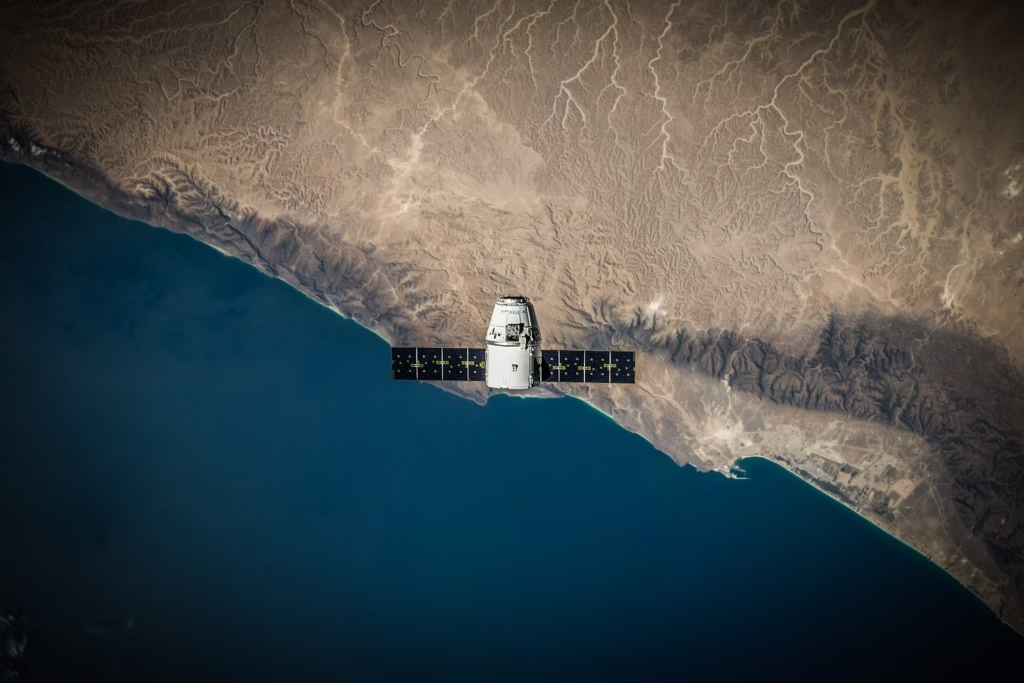
PHOTO: Space X on Unsplash
Australia has two pertinent documents highlighting Australia’s strategy in space: the Australian Civil Space Strategy and the Defence Space Strategy. The Civil Space Strategy’s priorities are the following: navigation, communications, earth observation, robotics and automation on earth and in space and Australia’s access to space.
The Defence Strategy similarly focuses on the building of self-reliant, sovereign space capabilities for intelligence, surveillance and reconnaissance, and the secure use of space. Informally, defence has looked to weaponise the use of space for defence purposes to protect Australians and Australian interests with the rhetoric of space as a physical battlefield domain becoming increasingly popular.
A major issue for Australia in space is that it currently has no sovereign space capability of its own, with no sovereign satellite capability of scale. What this means is that Australia relies on foreign satellite service provided from both allied nations and private corporations. Although unlikely, if relations were to sour between Australia and an ally the nation relies on in space, it could restrict Australia’s access to intelligence, cut off communications, and severely hamper Australia’s economy.
But this will not be the case forever. The Australian Defence Force has pledged $4 million AUD to a project in collaboration with Optus to develop and launch Australian made and owned satellites into LEO. The research will be undertaken by the University of Southern Queensland and the University of South Australia in collaboration with defence and industry for satellites that can be used for commercial, research and intelligence capabilities.
Politically and like every new capability, space literacy is lacking in policymakers. The risks and rewards of space as an operational domain is less understood than other domains but this will come with time as policymakers start to become aware of the many players in the space domain.
Where do we go from here?
With commercial actors already profiting off the use of space and allying itself with defence to increase operational capabilities, it seems that space is the next domain to permeate political and defence thought. But as space becomes more congested, and geopolitical tensions become fraught terrestrially, how we rise to meet the challenges of the final frontier remains to be seen.

Alice AE Jackson
Alice is a fourth year politics and international relations student passionate about space diplomacy, terrorism, and political violence. She enjoys researching and writing from a feminist perspective on foreign policy issues and national security. When they are not writing or studying, Alice is the campaigns advisor for Raise Our Voice Australia, a group dedicated to educating women and gender diverse people in politics and policy to bring gender equity to every level of politics. She is currently looking for post graduate degrees and what opportunities lie beyond university.